Making ready With out Predicting – A Wealth of Widespread Sense – Cyber Tech
A reader asks:
If you happen to don’t see it coming, how do you propose for it?
This query was in response to my 10 guidelines for coping with uncertainty.
I beloved the film The Holdovers. What can I say? I’m a sucker for a coming-of-age film.
Paul Giamatti performs a historical past trainer at a prep college for boys. This line caught with me when Giamatti describes the significance of learning historical past to one in every of his college students:
Historical past shouldn’t be merely the examine of the previous. It’s an evidence of the current.
My learn on the previous after learning a number of historical past is that the long run is unpredictable.
One in every of my favourite examples of this can be a memo written by Pentagon staffer Lin Wells to George W. Bush titled Predicting the Future.
Wells described each momentous shift in geopolitics by decade going again to the beginning of the twentieth century. Right here’s a few of the textual content:
If you happen to had been a safety coverage maker on the earth’s biggest energy in 1900, you’ll have been a Brit, trying warily at your age-old enemy, France.
By 1910, you’ll be allied with France and your enemy could be Germany.
By 1920, World Warfare I might have been fought and received, and also you’d be engaged in a naval arms race together with your erstwhile allies, the U.S. and Japan.
By 1930, naval arms limitations had been in impact, the Nice Despair was underway, and the protection planning normal mentioned, “no wars for ten years.”
9 years later World Warfare II had begun.
By 1950, Britain now not was the world’s biggest energy, the Atomic Age had dawned, and a “police motion” was underway in Korea.
The memo continued like this till the conclusion:
All of which is to say I’m undecided what 2010 will seem like, however I’m certain that it will likely be little or no like we anticipate, so we must always plan accordingly.
This letter was despatched in April 2001, simply months earlier than the 9/11 terrorist assaults. The 2000s decade included two wars, a large housing market crash and the largest monetary disaster because the Nice Despair.
Nobody may have probably predicted these outcomes forward of time.
As necessary as it’s to review historical past in an effort to perceive the current, you don’t have to return that far to know this concept. The 2020s have already been simply as unpredictable as ever.
The Economist produced a canopy story in November 2019 with forecasts from consultants about what may transpire in 2020:
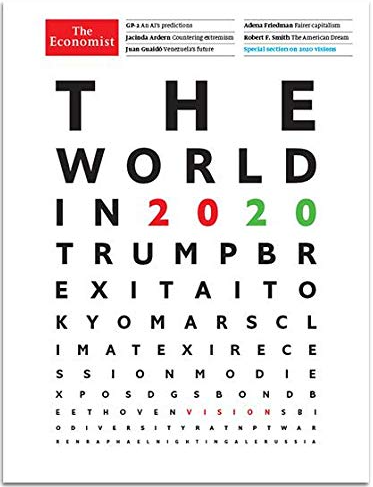
Their prediction listing included issues like a contentious Presidential election, Brexit, low/destructive rates of interest, U.S.-China relations, and so on.
Guess what wasn’t in there?
A pandemic that may shut the world down, trigger governments across the globe to unplug the economic system, then plug it again in by sending out trillions of {dollars} to residents and companies alike.
How may you probably predict that?
Right here’s what else nobody predicted coming into the 2020s:
- Oil costs turning destructive.
- Provide chain shocks.
- The quickest inventory market crash and restoration in historical past.
- The strongest labor market in a technology.
- 9% inflation that wouldn’t result in a recession.
- AI saving the economic system with the discharge of ChatGPT proper as inflation was peaking.
- The Tariff Tantrum following Liberation Day.
I may maintain going. None of it was predictable. If you happen to tried to construct a portfolio by predicting occasions like this it might be insane.
So what’s the answer?
How do you propose for these things for those who can’t predict it upfront?
Some ideas:
You settle for uncertainty as the start line. Admitting that you simply don’t understand how the long run will play out is liberating in some methods. It forces you to focus extra of your time on what actually issues.
You set expectations. An excellent plan does require baseline expectations with the understanding that there are outlier occasions. However you will need to acknowledge the distinction between issues that may occur and issues that normally occur. An excellent plan takes under consideration issues which might be possible, not the whole lot that’s doable.
You construct a variety of outcomes into your plan. I anticipate to see bull markets, bear markets, expansions, recessions, booms, busts, excessive charges, low charges, excessive inflation, low inflation, monetary crises and extra. However I do not know when these environments will happen, how lengthy they are going to final or the magnitude of the strikes.
You intend on these items taking place however haven’t any management over when or why. And timing these occasions is inconceivable.
You create a rules-based plan. Automating good choices upfront removes the necessity to predict what comes subsequent.
You give attention to what you management. You haven’t any management over the long run, what politicians do, geopolitical occasions, the financial cycle or the timing of bull/bear markets. You do management your threat profile, time horizon, asset allocation, funding bills and response to the occasions of the day.
You prolong your time horizon. Surprising occasions can have an effect over the quick run however are inclined to get smoothed out over the long term.
You diversify throughout situations. It’s inconceivable to diversify away each threat so that you attempt to make your portfolio sturdy sufficient to deal with totally different situations. Which means diversifying throughout asset courses, geography, market cap and technique.
You make course corrections alongside the way in which. Monetary plans will not be set in stone. You possibly can replace your plans as circumstances change. It’s essential to be versatile in an ever-changing world.
Invoice Candy joined me on the present once more this week to reply this query on Ask the Compound:
We additionally mentioned questions on in-plan Roth conversions, how box-spread ETFs work, utilizing a 529 plan for schooling later in life and the way a lot is an excessive amount of for personal illiquid investments.
Additional Studying:
Why Historical past Will get Stuff Unsuitable All of the Time

The best way to Get a Enterprise Credit score Card with an EIN Solely – Cyber Tech

Most Harmful Early Retirement Technique To Observe: Coast FIRE – Cyber Tech

Weekend studying: The Buying and selling Sport – Cyber Tech
About The Author

admin
Azeem Rajpoot, the author behind This Blog, is a passionate tech enthusiast with a keen interest in exploring and sharing insights about the rapidly evolving world of technology. With a background in Blogging, Azeem Rajpoot brings a unique perspective to the blog, offering in-depth analyses, reviews, and thought-provoking articles. Committed to making technology accessible to all, Azeem strives to deliver content that not only keeps readers informed about the latest trends but also sparks curiosity and discussions. Follow Azeem on this exciting tech journey to stay updated and inspired.
