Tim Stevens
Rear-wheel drive vehicles way back earned a popularity for being a little bit of a nightmare to reside with in snowy, icy situations. That is partly why Volvo stopped making the issues manner again within the Nineteen Nineties, so it was a shock that the model returned to rear-drive for its newest EVs, like its upcoming subcompact SUV, the EX30.
Why the throwback format? Subsequent-generation stability and traction-control techniques, aided by the exact torque supply of electrical motors, enable for superior modulation of energy and braking that will have been inconceivable on these ’90s icons. To see simply how effectively Volvo’s engineers succeeded on the process, I headed to northern Sweden to catch the tail of an Arctic winter and see whether or not this return to RWD was successful.
The pushed wheel dilemma
Because of inertia, having the engine of a automotive drive the rear wheels truly gives the acceleration. If you speed up, the automotive’s mass successfully shifts rearward. That extra weight on the rear wheels provides them extra grip—and offers you extra pace.
This works whether or not you are on dry roads or icy ones, however when grip is at a premium, turning will get extra sophisticated. Should you get too keen with the accelerator in a rear-wheel drive (RWD) automotive, attempting to speed up out of a nook, these rear wheels are inclined to spin. This kicks the automotive sideways, which, if you happen to’re not prepared for it, ends in an surprising spin.

Tim Stevens
That very same state of affairs is way safer in a front-wheel-drive (FWD) automotive. Speed up too laborious in a nook, and the entrance wheels spin, inflicting the nostril of the car to slip broad. That is simpler to catch and proper from behind the steering wheel, historically making these vehicles safer in slippery situations.
All-wheel drive (AWD) theoretically provides the very best of each worlds if you happen to do not thoughts paying a bit additional for the privilege and getting worse gasoline financial system alongside the way in which.
Provided that security is Volvo’s overriding precedence, it is smart that the model switched to focus totally on FWD and AWD vehicles within the late Nineteen Nineties. At this time, the most recent stability management techniques make it secure once more.
Methods to the rescue
To make RWD work on the brand new EX30 SUV, Volvo depends on a mixture of superior stability and traction management, once more aided by the exact management provided by electrical motors.
Traction management is a reasonably simple factor, a system that reduces the facility offered by the electrical motor or motors to forestall wheelspin. Stability management, nonetheless, is a little more nuanced. It really works with the traction management and likewise applies brakes to particular person wheels to assist the automotive flip. The final word aim is to maintain the SUV secure in decidedly unstable situations.
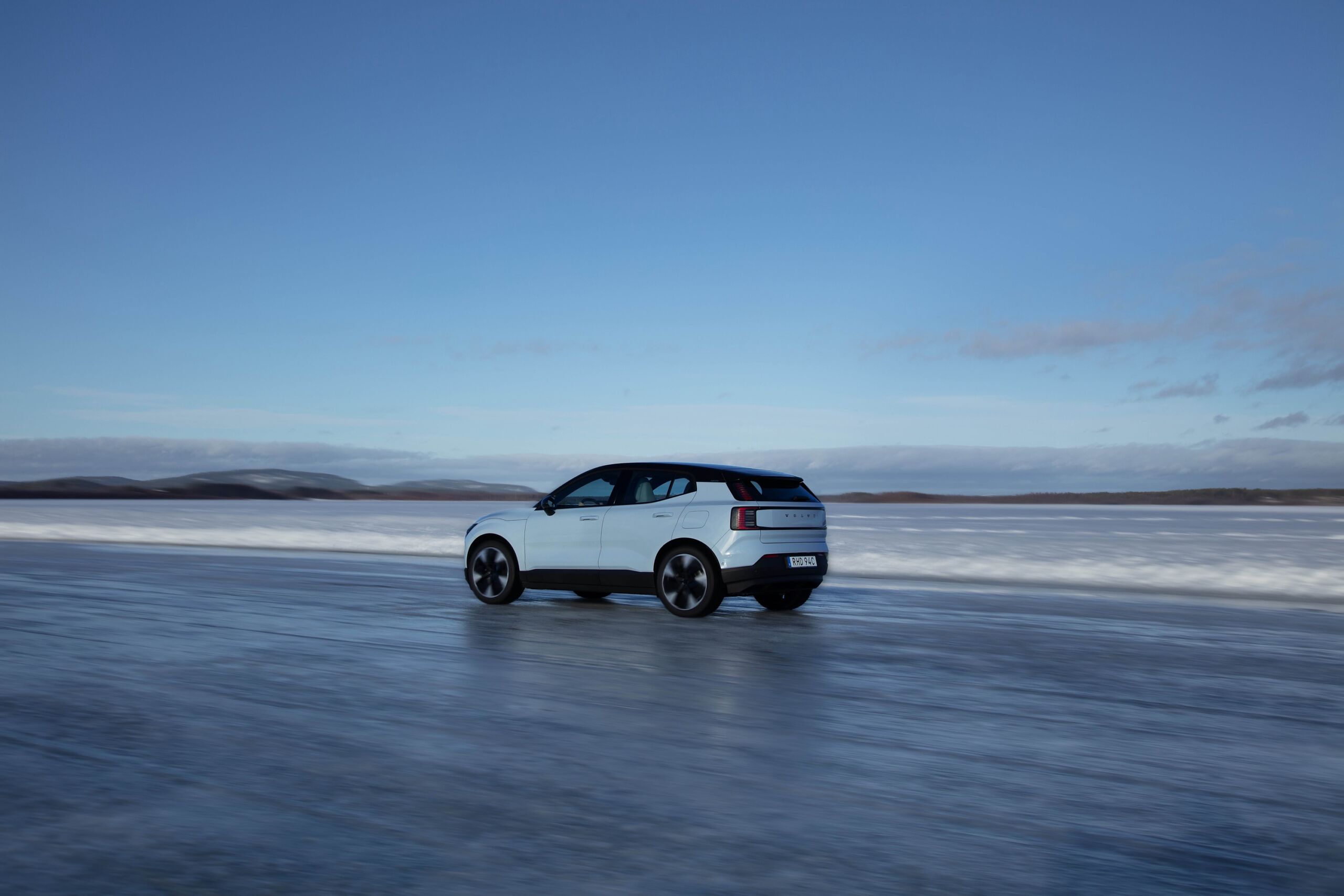
Volvo
You may learn our preliminary impressions of Volvo’s spectacular $34,950 SUV right here. That drive befell in sunny Portugal on dry roads. My flip on the wheel befell in snowy Sweden.
The snow and the ice are good locations to check out these digital smarts and sensors that Volvo baked into the brand new EX30. Their influence was most clearly felt within the RWD taste of the subcompact SUV. This single-motor model makes 268 hp plus 253 lb-ft of torque. As an EV, all that energy is delivered immediately to the wheels, which might make a mean RWD automotive an actual handful.
On glare ice, no much less on a frozen lake, the RWD EX30 pulled away cleanly from a whole cease. Even with the accelerator on the ground, there was solely a touch of wheelspin earlier than the traction-control system lower energy to offer a easy, regular getaway.
Regular, sure, however not significantly swift. With so little grip and solely two wheels pushed, persistence is required when driving the RWD EX30 on ice. That is not the case with the dual-motor AWD model. That EX30 completely launched ahead, even on ice. The traction management once more stored wheelspin to principally nothing, however twice the grip meant considerably extra acceleration.


