What SB 371 Means for You – Cyber Tech
Thousands and thousands of Southern Californians climb into Uber and Lyft autos each single day — heading to work in downtown Los Angeles, catching rides residence from Gaslamp in San Diego, or getting picked up after an evening out in Lengthy Seaside. Ridesharing has turn into as routine as driving, however many passengers do not know {that a} main authorized change took impact on January 1, 2026 that might considerably scale back the compensation they obtain if a crash leaves them injured.
California’s Senate Invoice 371 (SB 371) quietly reshaped the insurance coverage panorama for rideshare accident victims, slashing the uninsured and underinsured motorist (UM/UIM) protection that passengers can entry by means of Uber and Lyft. When you or a cherished one has been damage in a rideshare accident in Southern California, understanding this new regulation — and what protections stay — could possibly be the distinction between a good restoration and a devastating monetary shortfall.
What Is SB 371 and How Does It Have an effect on Rideshare Accident Victims in California?
Senate Invoice 371, signed into regulation throughout the 2025 California legislative session and efficient as of January 1, 2026, made a crucial change to the insurance coverage necessities for Transportation Community Corporations (TNCs) like Uber and Lyft. Particularly, it drastically lowered the obligatory uninsured/underinsured motorist (UM/UIM) protection these corporations should carry for passengers.
Earlier than this regulation took impact, Uber and Lyft had been required to keep up $1 million in UM/UIM protection per incident — a considerable security web that ensured passengers had been protected even when the opposite driver in a crash was uninsured or underinsured. Underneath SB 371, that determine was reduce to:
- $60,000 per particular person
- $300,000 per incident
That represents a discount of roughly 94% in per-person protection. In a area like Southern California — the place a single emergency room go to, CT scan, and brief hospital keep can simply exceed $50,000 — this transformation leaves many significantly injured passengers with protection that runs out lengthy earlier than their medical wants are met.
It’s crucial to grasp what SB 371 did not change. The $1 million third-party legal responsibility coverage that applies when the rideshare driver is at fault for the accident stays absolutely intact. The protection discount targets solely the UM/UIM element — conditions the place a third-party driver with little or no insurance coverage causes the crash. In extremely congested Southern California, the place practically one in six drivers operates with out ample insurance coverage, that is a gigantic hole.
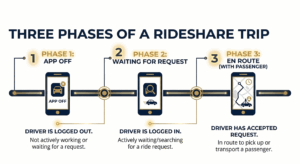
The three insurance coverage intervals in a California rideshare journey decide who pays after a crash below 2026 regulation.
Understanding the Three Insurance coverage Durations in a California Rideshare Journey
One of the crucial complicated points of any Uber or Lyft accident declare is figuring out which insurance coverage coverage truly applies. California regulation, ruled partially by California Public Utilities Code § 5433, divides every rideshare journey into distinct phases. Protection relies upon completely on which part the driving force was in in the meanwhile of the crash:
- Interval 1 – App Off: The motive force’s rideshare app is totally offline. On this state of affairs, solely the driving force’s private auto insurance coverage applies. Rideshare corporations carry no protection in any respect. If that private coverage has low limits or excludes business use, you’ll have very restricted recourse.
- Interval 2 – App On, Ready for a Trip Request: The motive force is logged into the app however has not but accepted a fare. Uber and Lyft present contingent legal responsibility protection at restricted ranges — sometimes $50,000 per particular person / $100,000 per accident for bodily harm, plus $25,000 for property injury — provided that the driving force’s private insurance coverage doesn’t apply.
- Interval 3 – En Path to Pickup or Transporting a Passenger: That is the part most individuals affiliate with a “rideshare trip.” When the driving force has accepted a visit and is both heading to select you up or actively carrying you, the total $1 million third-party legal responsibility coverage from Uber or Lyft prompts. Nonetheless, below SB 371, UM/UIM protection is now capped at $60,000 per particular person if the at-fault occasion is a 3rd driver.
Establishing precisely which interval applies requires a cautious overview of app information, GPS information, and police stories — proof your lawyer ought to collect instantly after an accident.
Why Did California Go SB 371? The Controversy Behind the Regulation
SB 371 didn’t cross with out opposition. The invoice grew to become a flashpoint between shopper advocates and rideshare giants, with Uber and Lyft lobbying closely for the change. Their acknowledged argument was that the $1 million UM/UIM requirement was excess of what is remitted for some other business car on California roads, and that the inflated prices had been being handed on to riders by means of increased fares.
Critics, together with the Shopper Attorneys of California (CAOC), pushed again forcefully. They argued that the laws successfully transfers monetary danger away from billion-dollar companies and onto the injured passengers least capable of take in it. The protection discount was additionally paired with a separate legislative deal: Meeting Invoice 1340, which gave rideshare drivers the fitting to unionize and have interaction in collective bargaining — a historic first for gig staff in California.
What Compensation Can You Nonetheless Get better After a Rideshare Accident in Southern California?
Regardless of the SB 371 adjustments, injured passengers, pedestrians, and different motorists nonetheless have significant authorized choices. The secret’s understanding which avenues of restoration stay open.
If the rideshare driver precipitated the accident, the $1 million legal responsibility coverage continues to be absolutely out there throughout Interval 3. This covers:
- Medical bills — emergency care, surgical procedure, rehabilitation, future medical therapy
- Misplaced wages and lack of incomes capability
- Ache and struggling — California doesn’t cap non-economic damages in commonplace private harm instances
- Property injury
- Wrongful loss of life damages for surviving relations
If a third-party uninsured driver precipitated the crash, restoration turns into extra advanced below SB 371. Nonetheless, injured passengers should still entry extra compensation by means of:
- Your personal private auto insurance coverage UM/UIM coverage — when you personal a car, your individual coverage can sometimes step in to cowl you as a passenger in another person’s car, together with an Uber or Lyft. Reviewing your individual protection limits earlier than you want them is sensible.
- Direct claims in opposition to the at-fault driver personally, together with their belongings
- Claims in opposition to third events — a faulty street, a negligent car producer, or a negligent employer of one other driver
- Medical health insurance for fast medical protection whereas the authorized declare is pending
An skilled Southern California rideshare accident lawyer will analyze each out there layer of protection to construct the strongest attainable restoration technique on your particular state of affairs.
Consulting a Southern California rideshare accident lawyer after an Uber or Lyft crash can shield your proper to full compensation.
The right way to Defend Your self After an Uber or Lyft Accident in Southern California
The moments and days following a rideshare accident are crucial. What you do — and what you keep away from doing — can considerably have an effect on the worth of your declare. Observe these steps rigorously:
- Name 911 instantly. Even when accidents appear minor, request police and emergency medical companies. A proper police report is foundational to any private harm declare. Don’t depend on Uber or Lyft’s in-app reporting as an alternative choice to an official regulation enforcement report.
- Search medical consideration directly. Frequent rideshare crash accidents — together with whiplash, traumatic mind accidents, and mushy tissue injury — might not produce apparent signs for hours or days. A documented medical analysis creates the evidentiary hyperlink between the accident and your accidents, which insurance coverage corporations will in any other case problem.
- Doc the scene totally. {Photograph} all car injury, street circumstances, visitors indicators, skid marks, and your seen accidents. Screenshot the journey particulars out of your Uber or Lyft app, together with the driving force’s title, car info, and the exact time and GPS route of your trip.
- Acquire witness info. Names and cellphone numbers of bystanders who noticed the crash might be invaluable when legal responsibility is disputed.
- Don’t give recorded statements to any insurance coverage adjuster — not the rideshare firm’s insurer, not the opposite driver’s insurer, and probably not even your individual — earlier than consulting with an lawyer. Early statements are routinely used to reduce or deny claims.
- Report the accident within the app. Use the Uber or Lyft security reporting perform inside the app to create a proper file with the rideshare firm, along with your police report.
- Seek the advice of a rideshare accident lawyer promptly. Underneath California Code of Civil Process § 335.1, you typically have two years from the date of the accident to file a private harm lawsuit. Appearing early preserves proof, secures witness recollections, and offers your authorized group probably the most choices.
The Function of Proposition 22 in California Rideshare Accident Claims
Any dialogue of Uber and Lyft legal responsibility in California should account for Proposition 22, the 2020 poll initiative that labeled rideshare and supply drivers as unbiased contractors reasonably than workers. This distinction carries monumental sensible penalties for injured victims.
As a result of Uber and Lyft drivers should not legally labeled as workers, the businesses typically can’t be held vicariously accountable for driver negligence below the normal employer-employee doctrine. As an alternative, injured events sometimes pursue claims by means of the rideshare firm’s insurance coverage insurance policies reasonably than immediately in opposition to the company itself as an employer. This framework shifts the main target as to whether the required insurance coverage protection applies — and with SB 371’s reductions in UM/UIM limits, that protection is now thinner than at any level in latest California historical past.
Nonetheless, direct company legal responsibility in opposition to Uber or Lyft should still be out there in narrower circumstances, equivalent to when the corporate was negligent in its driver screening, background verify processes, or car upkeep necessities. Courts have continued to scrutinize these corporations’ accountability obligations even below Prop 22’s constraints.
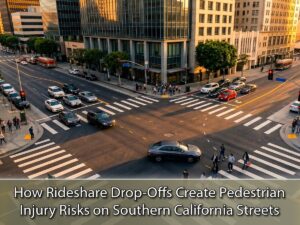
Rideshare car drop-offs in crosswalks and bike lanes create critical harm dangers for pedestrians and cyclists in Southern California.
Particular Considerations: Pedestrians, Cyclists, and Different Drivers Struck by Rideshare Autos
Rideshare accident claims should not restricted to passengers. Southern California’s dense city setting signifies that Uber and Lyft autos often work together with cyclists, pedestrians, and motorists in advanced visitors eventualities. Drop-offs in bike lanes, pickups at crosswalks, and sudden stops on congested streets like Wilshire Boulevard, Sundown Boulevard, and Pacific Coast Freeway create fixed hazard zones for non-passengers.
When you had been struck by an Uber or Lyft car as a pedestrian, bicycle owner, or occupant of one other car and the rideshare driver was at fault throughout Interval 3, you’re probably entitled to assert in opposition to the total $1 million third-party legal responsibility coverage. The SB 371 reductions in UM/UIM protection don’t have an effect on this pathway — they solely have an effect on the separate state of affairs the place a unique, uninsured driver is at fault and you’re looking for protection by means of the rideshare firm’s UM/UIM coverage.
Pedestrian and bicycle accident victims in these instances usually maintain a number of the most catastrophic accidents: damaged bones, spinal wire accidents, traumatic mind accidents, and within the worst instances, deadly outcomes. California regulation doesn’t cap non-economic damages in these instances, that means a talented lawyer can pursue full compensation for ache, struggling, and the long-term affect in your high quality of life.
How SB 371 Modifications Your Settlement Technique: What Attorneys Are Doing In another way in 2026
Skilled Southern California private harm attorneys have already adjusted their method to rideshare accident instances in gentle of SB 371. If you’re evaluating authorized illustration for a rideshare harm declare, ask whether or not your lawyer is taking the next steps:
- Reviewing your private auto insurance coverage coverage on the outset of each rideshare case to find out whether or not your individual UM/UIM protection can complement the lowered rideshare firm limits
- Pursuing all out there defendants — together with the at-fault third-party driver and some other probably liable events — to maximise restoration past the UM/UIM caps
- Preserving app information and GPS information instantly, earlier than they’re overwritten or turn into unavailable, to nail down which insurance coverage interval applies
- Constructing complete damages packages that absolutely doc future medical prices, misplaced incomes capability, and non-economic losses — guaranteeing that any out there coverage limits are absolutely justified
- Monitoring the November 2026 poll initiative and advising purchasers on timing issues that will have an effect on the decision of lively claims
Key Information About Rideshare Accident Claims and SB 371 in Southern California
Here’s a condensed reference information for accident victims and their households navigating the post-SB 371 panorama:
- Efficient date of SB 371: January 1, 2026
- UM/UIM protection earlier than SB 371: $1,000,000 per incident
- UM/UIM protection after SB 371: $60,000 per particular person / $300,000 per incident
- Third-party legal responsibility throughout Interval 3: Nonetheless $1,000,000 — unchanged by SB 371
- Protection throughout Interval 2 (app on, no trip accepted): $50,000 per particular person / $100,000 per accident bodily harm
- Driver classification: Impartial contractor below Proposition 22
- Statute of limitations: 2 years from the accident date below CCP § 335.1
- Finest step after a crash: Contact a Southern California rideshare accident lawyer earlier than talking to any insurance coverage adjuster
- Governing authority: California Public Utilities Fee (CPUC)
How SB 371 Modified Protection for Rideshare Accidents in SoCal
Injured in an Uber or Lyft Accident in Southern California? Napolin Accident Damage Lawyer Is Right here to Struggle for You.
The insurance coverage adjustments introduced by SB 371 make it extra necessary than ever to have an skilled, aggressive advocate in your aspect from the second an accident happens. At Napolin Accident Damage Lawyer, now we have constructed our observe within the coronary heart of Southern California preventing for the rights of people that have been damage by means of no fault of their very own — together with riders, passengers, pedestrians, and motorists impacted by rideshare accidents.
Our agency understands the advanced, multi-layered insurance coverage construction that governs Uber and Lyft accident claims, and we all know learn how to navigate the adjustments SB 371 launched in 2026. We take a deeply personalised method to each case, taking the time to grasp your accidents, your losses, and your targets earlier than constructing a method tailor-made to your wants. We’re dedicated to pursuing the most compensation out there below California regulation — not the primary lowball supply an insurance coverage adjuster places on the desk.
Our observe file of profitable ends in Southern California private harm instances speaks for itself. While you work with Napolin Accident Damage Lawyer, you aren’t a case quantity — you’re a particular person whose restoration issues to us.
Name us immediately at (866)-NAPOLIN for a free, no-obligation session. We deal with rideshare accident instances on a contingency charge foundation — you pay nothing except we win for you. Don’t wait: the proof you want begins disappearing the second the crash occurs.

Alexander Drew Napolin is an Accident Damage Lawyer in California. His observe focus is auto accident harm, staff’ compensation, private harm, wrongful loss of life, and normal negligence litigation.

Patchwork Legislation (Love) – Cyber Tech

An Overview of California’s Business Truck Insurance coverage Legal guidelines – Cyber Tech
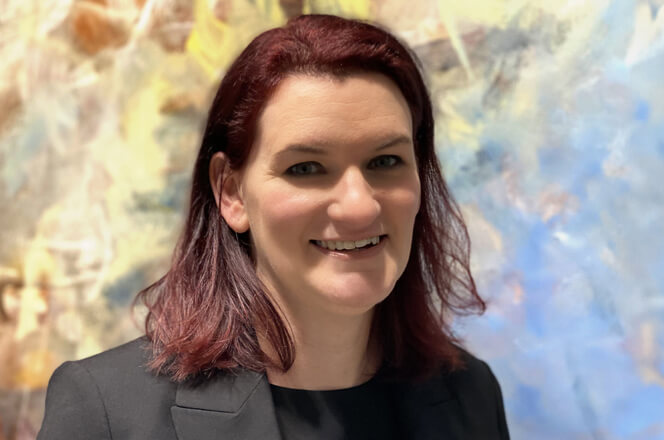
Jacqui Cadman was honored to be chosen and function a choose for the UMD Carey Regulation’s Felony Protection Clinic’s mock suppression hearings. – Cyber Tech
About The Author

admin
Azeem Rajpoot, the author behind This Blog, is a passionate tech enthusiast with a keen interest in exploring and sharing insights about the rapidly evolving world of technology. With a background in Blogging, Azeem Rajpoot brings a unique perspective to the blog, offering in-depth analyses, reviews, and thought-provoking articles. Committed to making technology accessible to all, Azeem strives to deliver content that not only keeps readers informed about the latest trends but also sparks curiosity and discussions. Follow Azeem on this exciting tech journey to stay updated and inspired.
